Emergency Dentist vs. Emergency Room

If you experience a dental emergency, it is important to know an emergency dentist is just a phone call away. Many dentists who provide emergency services make themselves available 24 hours a day, as emergencies can arise at any time. Emergency dentists are professionals who treat walk-in and last-minute patients who require immediate care. Emergency dental care is available at Bison Dentistry in Tonawanda and the surrounding area. In the case of a dental emergency, you should ideally contact our office first. However, there may be times — such as when an issue arises at night, over the weekend, or on a holiday — when your first instinct is to rush to the emergency room. In these situations, carefully consider the severity of the problem and whether it necessitates ER care.

Dental emergencies can arise at any time of day or night, and in a variety of situations. When one does, call Bison Dentistry at (716) 696-1951 to get the immediate treatment you need.

When To Go Straight to the ER

Per the American Dental Association, the number of dental-related ER visits nearly doubled, from 1.1 million to 2.1 million, between 2000 and 2010. Despite the increase in numbers, there are actually very few dental-related concerns for which patients should head immediately to their hospital’s ER department.

When a Patient Experiences Trauma to the Face

If a blow to the face or accident results in chipped, cracked, or lost teeth, an emergency dentist should be equipped to handle the situation. However, when the accident or incident causes extensive facial trauma, such as broken bones, puncture wounds, lacerations, or damage to the soft tissues, it may be a good idea for the injured party to seek medical care before emergency dental care. Emergency dentists may have the capacity to restore oral health, but most cannot set broken bones, sew up lacerations, or perform other extensive medical procedures.

When an Emergency Dentist Is Unavailable

If someone experiences a dental emergency aside from those mentioned above, and if an emergency dentist is not immediately available to handle it, then the patient should head to the hospital. Though ER personnel may not be able to treat the underlying condition, they can help the patient manage the pain and other symptoms until an emergency dentist becomes available.

“There are actually very few dental-related concerns for which patients should head immediately to their hospital’s ER department.”

When To Call a Local Emergency Dentist First

In the majority of oral health emergencies, patients should contact their emergency dentists before heading to the ER. In addition to helping patients manage symptoms, dental professionals can treat underlying conditions and ensure they do not grow worse. For individuals who are not sure what constitutes a “dental emergency” as opposed to a non-urgent yet uncomfortable situation, the ADA provides guidance. Per the ADA, a dental emergency is a situation characterized by one or more of the following:

  • Bleeding that will not stop
  • Infection accompanied by swelling or pain
  • Painful swelling around or in the mouth, with or without infection
  • Chipped, broken, or dislocated teeth
  • Abscess with localized pain and swelling and no signs of complications
  • Loss of a permanent or temporary restoration

Other problems that may necessitate immediate but not emergency care include broken, irritating, or malfunctioning dentures; oral sutures; and bent or broken orthodontic appliances or wires.

“In addition to helping patients manage symptoms, dental professionals can treat underlying conditions and ensure they do not grow worse.”

What Emergency Dental Treatment Entails

Emergency dental treatment looks different for everyone, as no two dental issues are exactly the same. However, some occurrences are more common than others, which means there are certain treatments emergency dentists perform more often than others. Examples of frequently performed emergency dental procedures include:

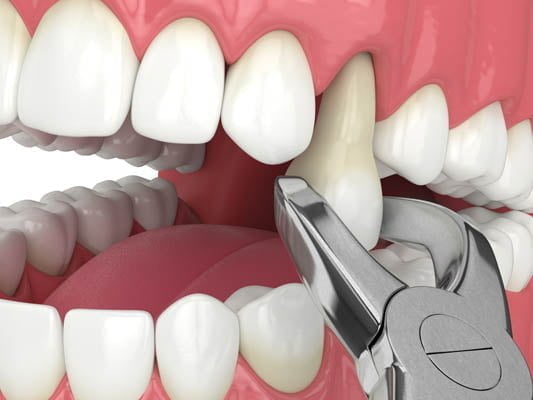
  • Tooth extraction
  • Tooth replacement (placing a knocked-out tooth back in the socket)
  • Filling or crown replacement
  • Tooth restoration

Regardless of what brings a patient to an emergency dentist’s office, dental teams typically thoroughly clean the mouth and around the affected area, take X-rays of the mouth, and focus on pain and infection management.

“There are certain treatments emergency dentists perform more often than others.”

Frequently Asked Questions

Emergency dental issues are ones that require immediate attention to either preserve the tooth or alleviate pain and infection. However, because the definition of a dental emergency is vague for most people, patients should call their dentist if they have any concerns. Otherwise, pay attention for severe pain, exposed roots, excessive bleeding, infection, and swelling.
Unfortunately, in almost all instances, emergency dental visits are more expensive than regular visits. However, how much more depends on the dentist you visit and the treatment necessary. That said, you should not let cost deter you from seeking immediate care.
If you have dental coverage, it may cover the cost of emergency dentistry. However, you should review your policy or talk to your provider to get an accurate answer. Dental insurance does not cover visits to the ER.
If you visit the ER for an emergency dental issue, your medical coverage should cover the cost of the visit. It should also cover the cost of prescriptions related to the issue. However, again, you should check your policy to see what it does and does not cover.
The job of an emergency dentist is to be available when other providers are not. As a result, most emergency dental offices accept walk-ins 24/7. Many require patients to call an emergency hotline first, which will connect them to the dentist.

Request Appointment

Name(Required)

What To Ask Your General Dentist When Preparing for a Crown

If a general dentist recommends a dental crown, there are a variety of reasons why. Crowns can be used for cosmetic corrections as well as ...
Read More →

Why Is It Important to Go in for Professional In-Office Teeth Whitening?

Learn why in-office teeth whitening procedures are preferred over at-home treatment and over-the-counter options.
Read More →

A General Dentist Discusses Essentials for Good Oral Health

Any general dentist knows that oral health is about more than just strong teeth. It is also a bellwether of overall physical health, which makes ...
Read More →

How a General Dentist Treats Cavities

Among the most common dental problems that a general dentist treats are cavities. Most people will experience this form of tooth decay at some point ...
Read More →

How Many Visits Does It Take to Get a Dental Crown?

When getting a dental crown, you might wonder how many visits you need to make before you can get the restoration.
Read More →

A General Dentist Talks Tooth Extractions

Patients may be alarmed if a general dentist mentions that a tooth extraction may be needed during a routine appointment. A dentist’s primary goal is ...
Read More →